
The Sword of Discernment
Introduction into the doctrines of Amun

This text is quite different from the previous one in terms of structure and content. Just as within the Corpus Hermeticum, the first tractate is a firsthand account of Hermes experiencing Gnosis and hearing Poimandres tell him about the nature of Creation and the Universe. Then the rest of the tractates within the Corpus are conversations between teacher and pupil talking about the more technical areas of their theology.
It is the same here. In this second text, we have a Master of Wisdom, a sort of highest teacher character within a group or occult order. We then have a Seeker who has been a student within this group looking deeply for answers where no other of the students have ventured yet, and so as a reward he gets to talk to the Master to learn the deepest mysteries of the order.
I take alot of inspiration from different texts of the Corpus Hermeticum, especially the second one “To Asclepius” that I pretty much directly quote several times at the beginning of my text.
The idea of True Will is also taken straight from Thelemic ideas, started by Aleister Crowley. In this text, however, I differ slightly in the method of learning ones True Will.
Again, I will add pictures of the original written texts, and footnotes next to things I may have to explain.
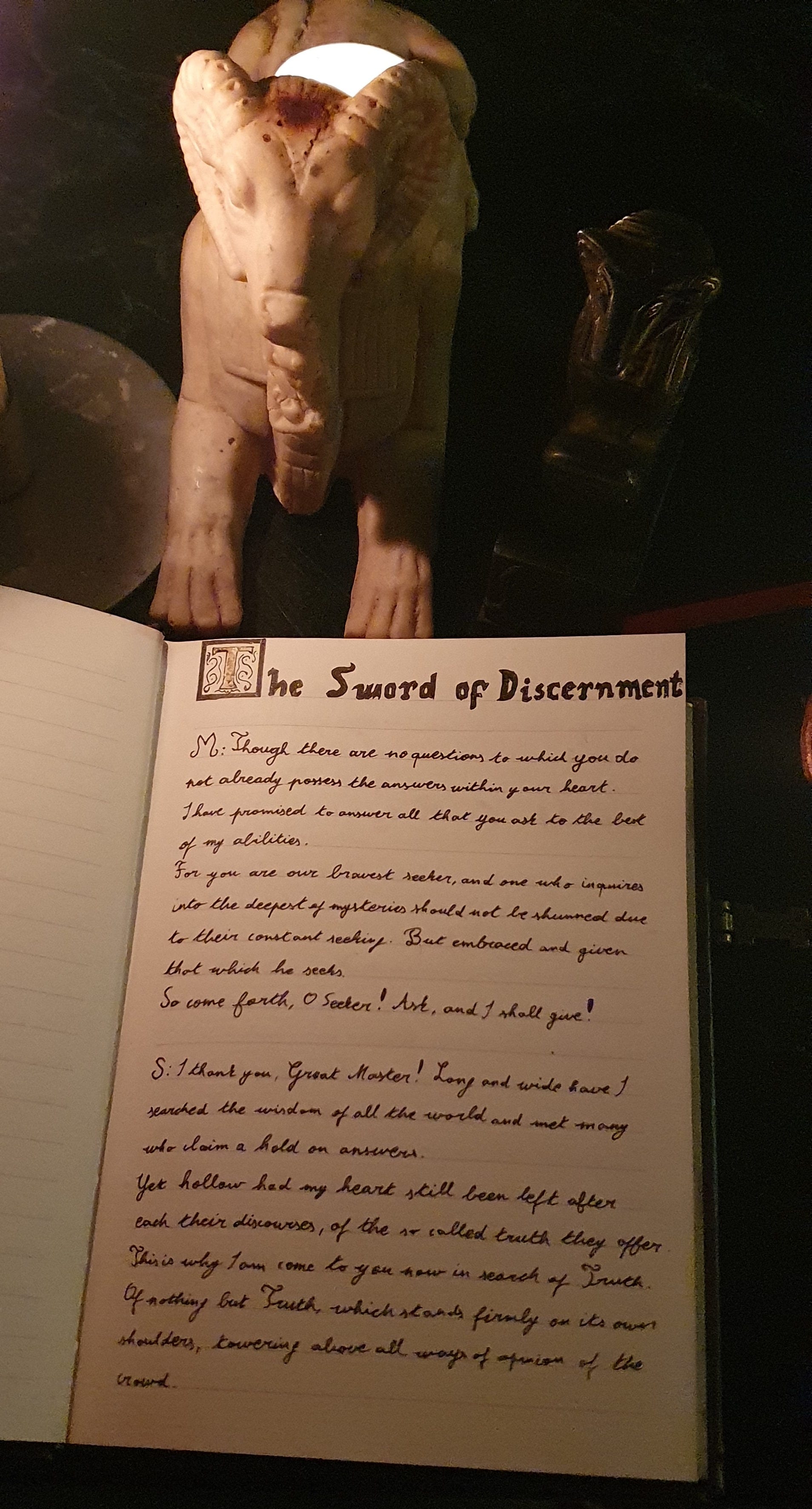
M: Though there are no questions to which you do not already possess the answers within your heart.1
I have promised to answer all that you ask to the best of my abilities.
For you are our bravest seeker, and one who inquires into the deepest of mysteries should not be shunned due to their constant seeking. But embraced and given that which he seeks.
So come forth, O Seeker! Ask, and I shall give!
S: I thank you, Great Master! Long and wide have I searched the wisdom of all the world and met many who claim a hold on answers.
Yet hollow had my heart still been left upon their discourses, of the so called truth they offer.
This is why I am come to you now in search of Truth. Of nothing but Truth, which stands firmly on its own shoulders, towering above all ways of opinion of the crowd.2
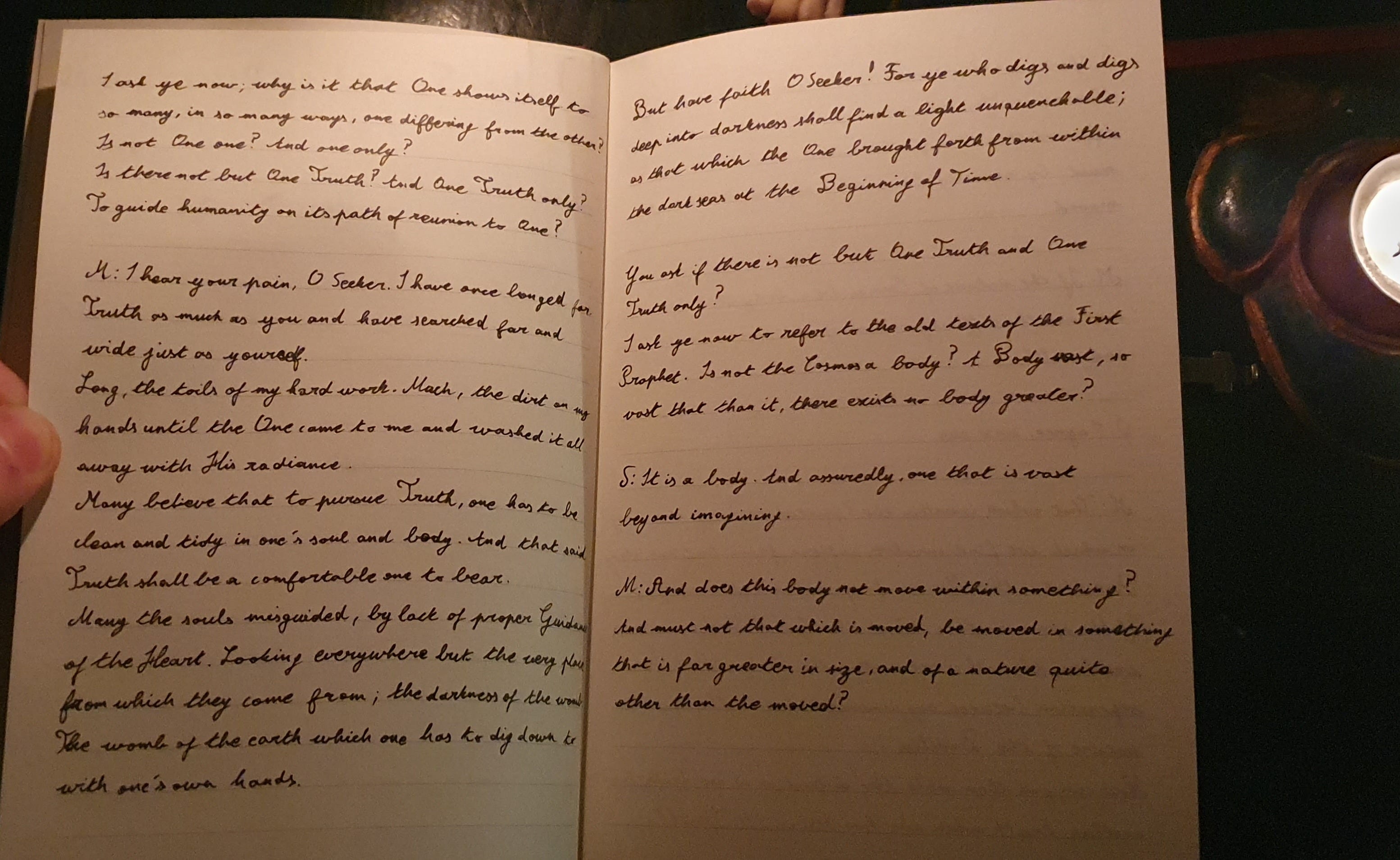
I aske ye now; why is it that One3 shows Itself to so many, in so many ways, one differing from the other? Is not One one? And one only?
Is there not but One Truth? And One Truth only? To guide humanity on its path of reunion to One.
M: I hear your pain, O Seeker. I have once longed for Truth as much as you and have searched far and wide just as yourself.
Long, the toils of my hard work. Much, the dirt on my hands until the One came to me and washed it all away with His radiance.
Many believe that to pursue Truth, one has to be clean and tidy in one's soul and body. And that said Truth shall be a comfortable one to bear.4
Many the souls misguided, by lack of proper Guidance of the Heart. Looking everywhere but the very place from which they come from; the darkness of the womb. The womb of the earth which one has to dig down to with one's own hands.
But have faith O Seeker! For ye who digs and digs deep into darkness shall find a light unquenchable; as that which the One brought forth from within the dark seas at the Beginning of Time.
You ask if there is not but One Truth and One Truth only?
I ask ye now to refer to the old texts of the First Prophet.5 Is not the Cosmos a Body? A Body vast, so vast that than it, there exists no body greater?6
S: It is a body. And assuredly, one that is vast beyond imagining.
M: And does this body not move within something? And must not that which is moved, be moved in something that is far greater in size and of a nature quite other than the moved?
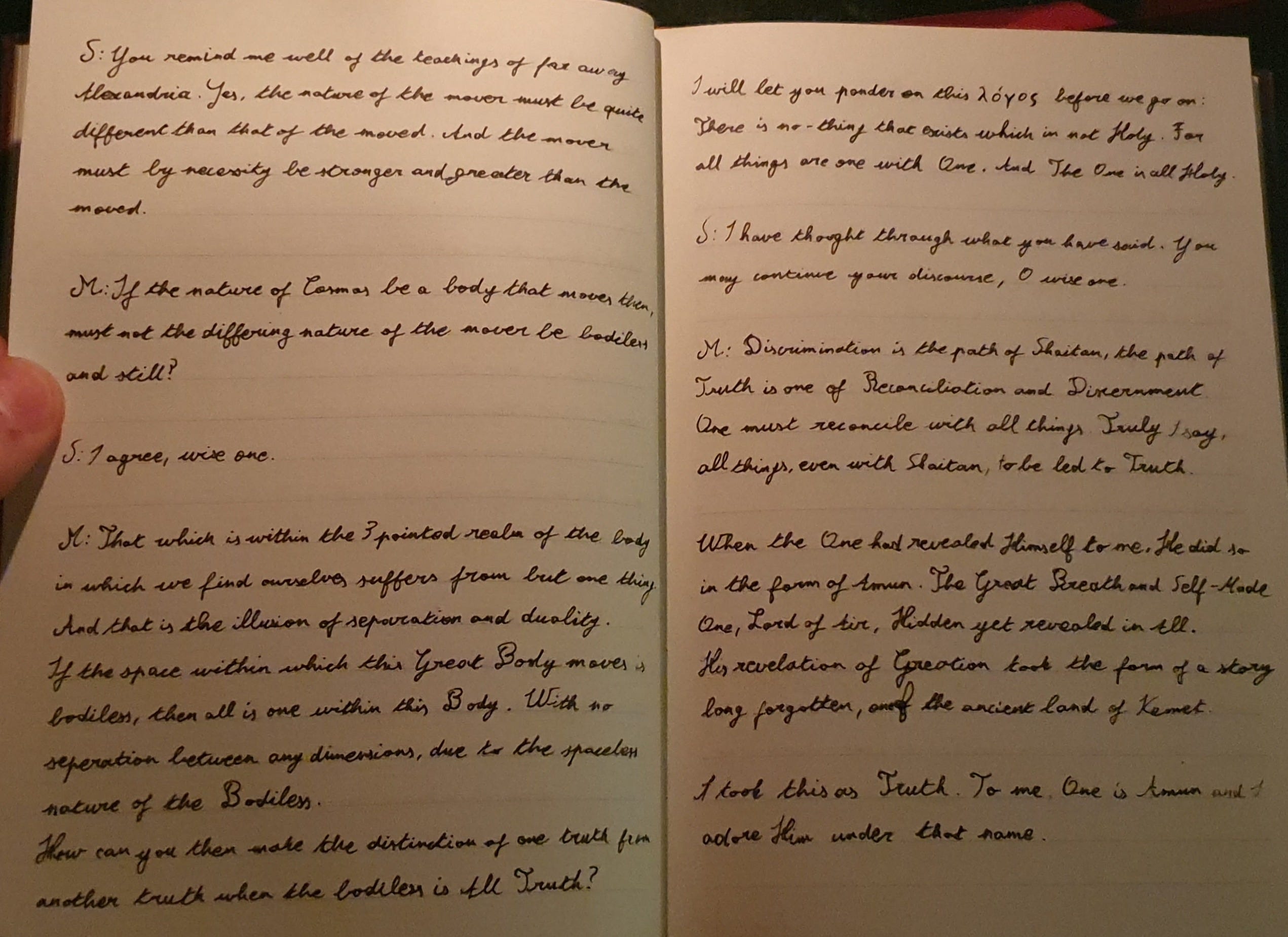
S: You remind me well of the teachings of far away Alexandria. Yes, the nature of the mover must be quite different than that of the moved. And the mover must by necessity be stronger and greater than the moved.
M: If the nature of Cosmos be a body that moves then, must not the differing nature of the mover be bodiless and still? 7
S: I agree, wise one.
M: That which is within the 3 pointed realm8 of the body in which we find ourselves suffers from but one thing. And that is the illusion of seperation and duality.
If the space within which this Great Body of ours moves is bodiless, then all is one within this Body. With no seperation between any dimensions, due to the spaceless nature of the bodiless.
How can you then make the distinction of one truth from another truth when the bodiless is All Truth?
I will let you ponder on this λόγος(Logos) before we go on: There is no-thing that exists which is not Holy. For all things are one with One. And The One is all Holy.9
S: I have thought through what you have said. You may continue your discourse, O wise one.
M: Discrimination is the path of Shaitan10, the path of Truth is one of Reconciliation and Discernment.
One must reconcile with all things. Truly I say, all things, even with Shaitan11, to be led to Truth.
When the One had revealed Himself to me, He did so in the form of Amun. The Great Breath and Self-Made One, Lord of Air, Hidden yet Revealed in All. His Revelation of Creation took the form of a story long forgotten, one of the ancient land of Kemet.12
I took this as Truth. To me, One is Amun and I adore Him under that name.
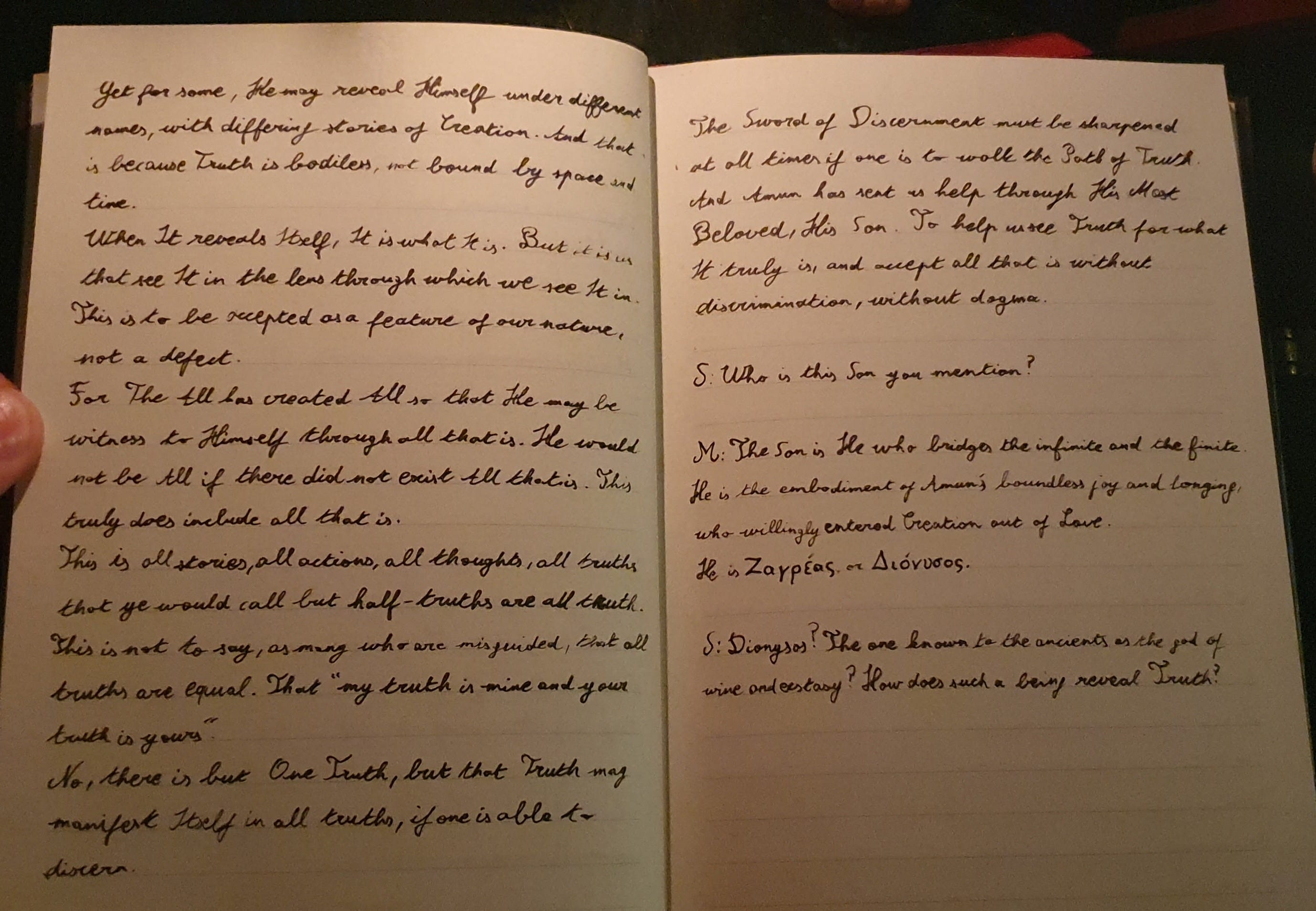
Yet for some, He may reveal Himself under different names, with differing stories of Creation. And that is because Truth is bodiless, not bound by space and time.13
When It reveals Itself, It is what It is. But it is us that see It in the lens through which we see It in. This is to be accepted as a feature of our nature, not a defect.14
For The All has created All so that He may be witness to Himself through all that is. He would not be All if there did not exist All that Is. This truly does include all that is. This is all stories, all actions, all thoughts, all truths that ye would call but half-truths are all truth.
This is not to say, as many who are misguided, that all truths are equal. That "my truth is mine and your truth is yours."
No, there is but One Truth, but that Truth may manifest Itself in all truths, if one is able to discern.15
The Sword of Discernment must be sharpened at all times if one is to walk the Path of Truth.
And Amun has sent us help through His Most Beloved, His Son. To help us see Truth for what It truly is, and accept all that is without discrimination, without dogma.
S: Who is this Son you mention?
M: The Son is He who bridges the infinite and the finite. He is the embodiment of Amun's boundless joy and longing, who willingly entered Creation out of Love. He is Ζαγρέας(Zagreυs), or Διόνυσος (Dionysos).
S: Dionysos? The one known to the ancients as the god of wine and ecstasy? How does such a being reveal Truth?
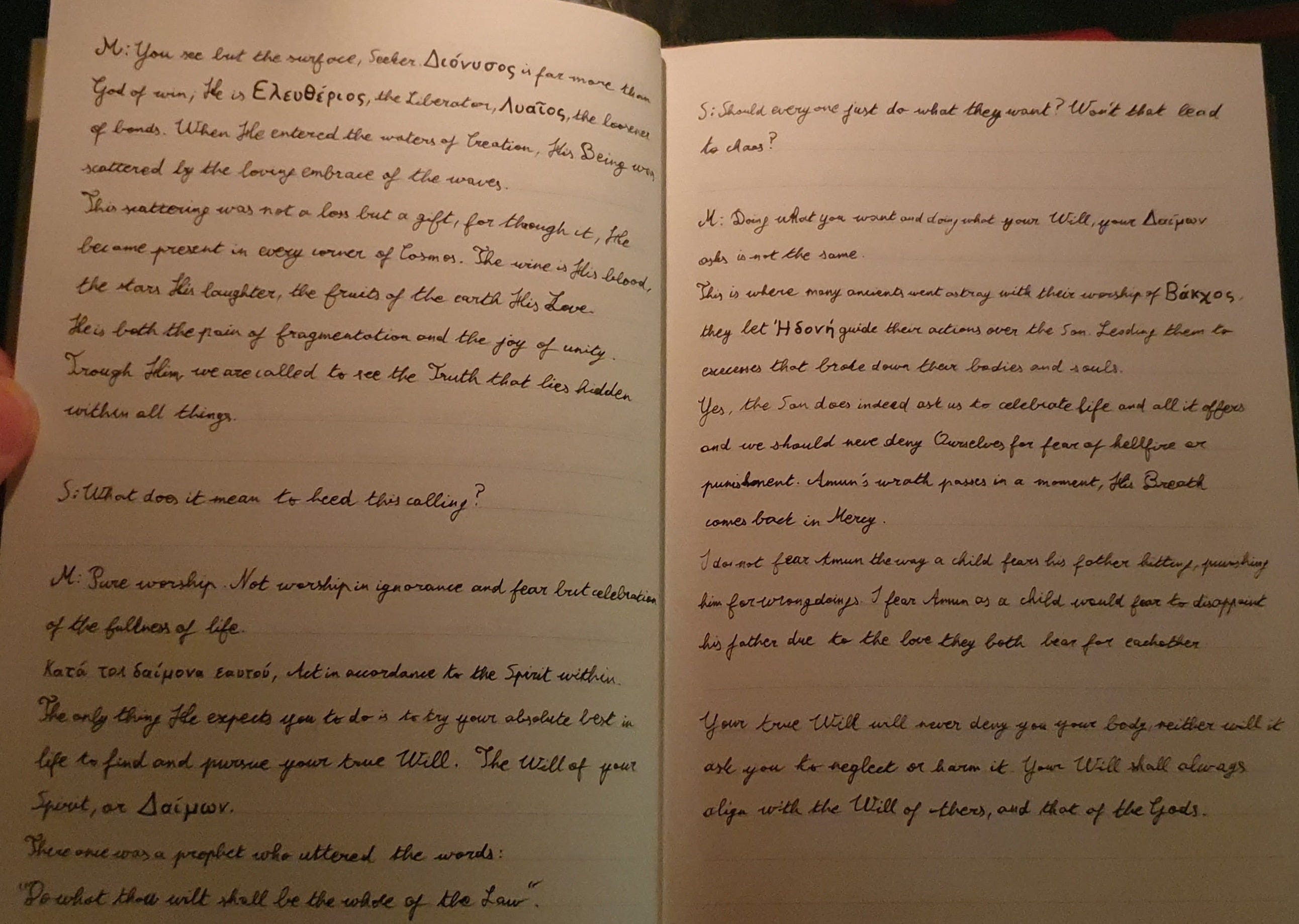
M: You see but the surface, Seeker. Διόνυσος is far more than God of wine; He is Ελευθέριος (Eleutherios), the Liberator, Λυαῖος (Lyaios), the Loosener of bonds. When He entered the waters of Creation, His Being was scattered by the loving embrace of the waves.
This scattering was not a loss but a gift, for through it, He became present in every corner of Cosmos. The wine is His blood, the stars His laughter, the fruits of the earth His Love. He is both the pain of fragmentation and the joy of unity. Through Him, we are called to see the Truth that lies hidden within all things.
S: What does it mean to heed this calling?
M: Pure worship. Not worship in ignorance and fear, but celebration of the fullness of life.
Κατά τον δαίμονα εαυτού16, Act in accordance to the Spirit within. The only thing He expects of you is that you try your absolute best in life to find and pursue your true Will. The Will of your Spirit, or Δαίμων (Daimon).
There once was a prophet who uttered the words: "Do what thou wilt shall be the whole of the Law".17
S: Should everyone just do what they want? Won't that lead to chaos?
M: Doing what you want and doing what your Will, your Δαίμων asks is not the same.
This is where many ancients went astray with their worship of Βάκχος (Bacchos)18, they let Ήδονή (Hedone)19 guide their actions over the Son. Leading them to excesses that broke down their bodies and souls.
Yes, the Son does indeed ask us to celebrate life and all it offers and we should never deny Ourselves for fear of hellfire or punishment.
Amun's wrath passes in a moment, His Breath comes back in Mercy.
I do not fear Amun the way a child fears his father hitting, punishing him for wrongdoings.
I fear Amun as a child would fear to disappoint his father due to the love they both bear for eachother.20
Your true Will will never deny you your body, neither will it ask you to neglect or harm it. Your Will shall always align with the Will of others, and that of the Gods.21
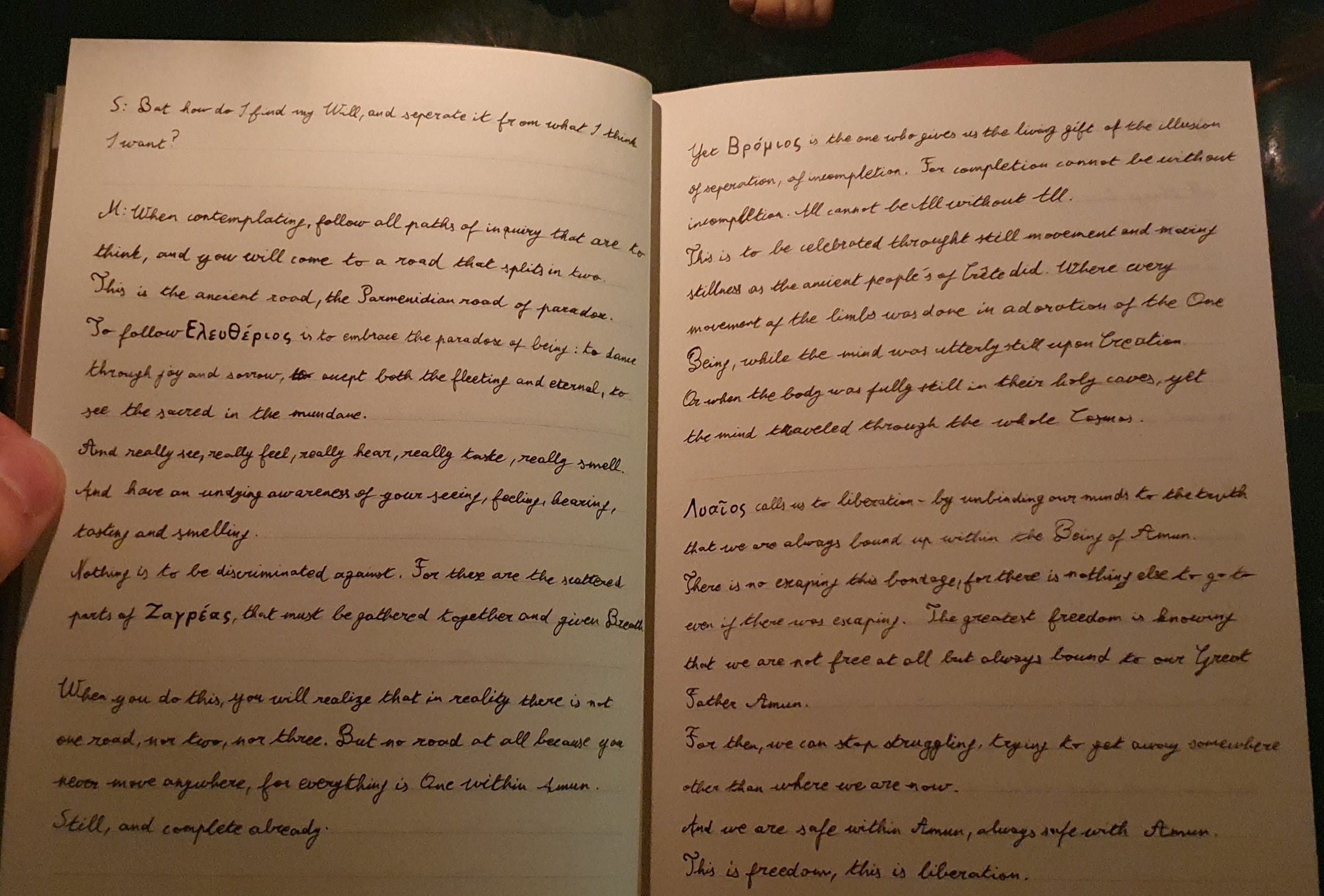
S: But how do I find my Will, and seperate it from what I think I want?
M: When contemplating, follow all paths of inquiry that are to think, and you will come to a road that splits in two. This is the ancient Parmenidian road of paradox.22
To follow Ελευθέριος is to embrace the paradox of being: to dance through joy and sorrow, to accept both the fleeting and eternal, to see the sacred in the mundane.
And really see, really feel, really hear, really taste, really smell. And have an undying awareness of your seeing, feeling, hearing, tasting, smelling.23
Nothing is to be discriminated against. For these are the scattered parts of Ζαγρέας, that must be gathered together and given Breath. 24
When you do this, you will realize that in reality there is not one road, nor two, nor three. But no road at all because you never move anywhere, for everything is One within Amun. Still, and complete already.
Yet Βρόμιος (Bromios) is the one who gives us the living gift of the illusion of seperation, of incompletion. For completion cannot be without incompletion. All cannot be All without All.25
This is to be celebrated through still movement and moving stillness as the ancient people's of Crete did26. Where every movement of the limbs was done in adoration of the One Being, while the mind was utterly still upon Creation.
Or when the body was fully still in their holy caves, yet the mind traveled through the whole Cosmos.27
Λυαῖος calls us to liberation—by unbinding our minds to the truth that we are always bound up within the Being of Amun.
There is no escaping this bondage for there is nothing else to go to even if there was escaping. The greatest freedom is knowing that we are not free at all but always bound to our Great Father Amun.28
For then, we can stop struggling, trying to get away somewhere other than where we are now.
And we are safe within Amun. Always safe with Amun.
This is freedom, this is liberation.29
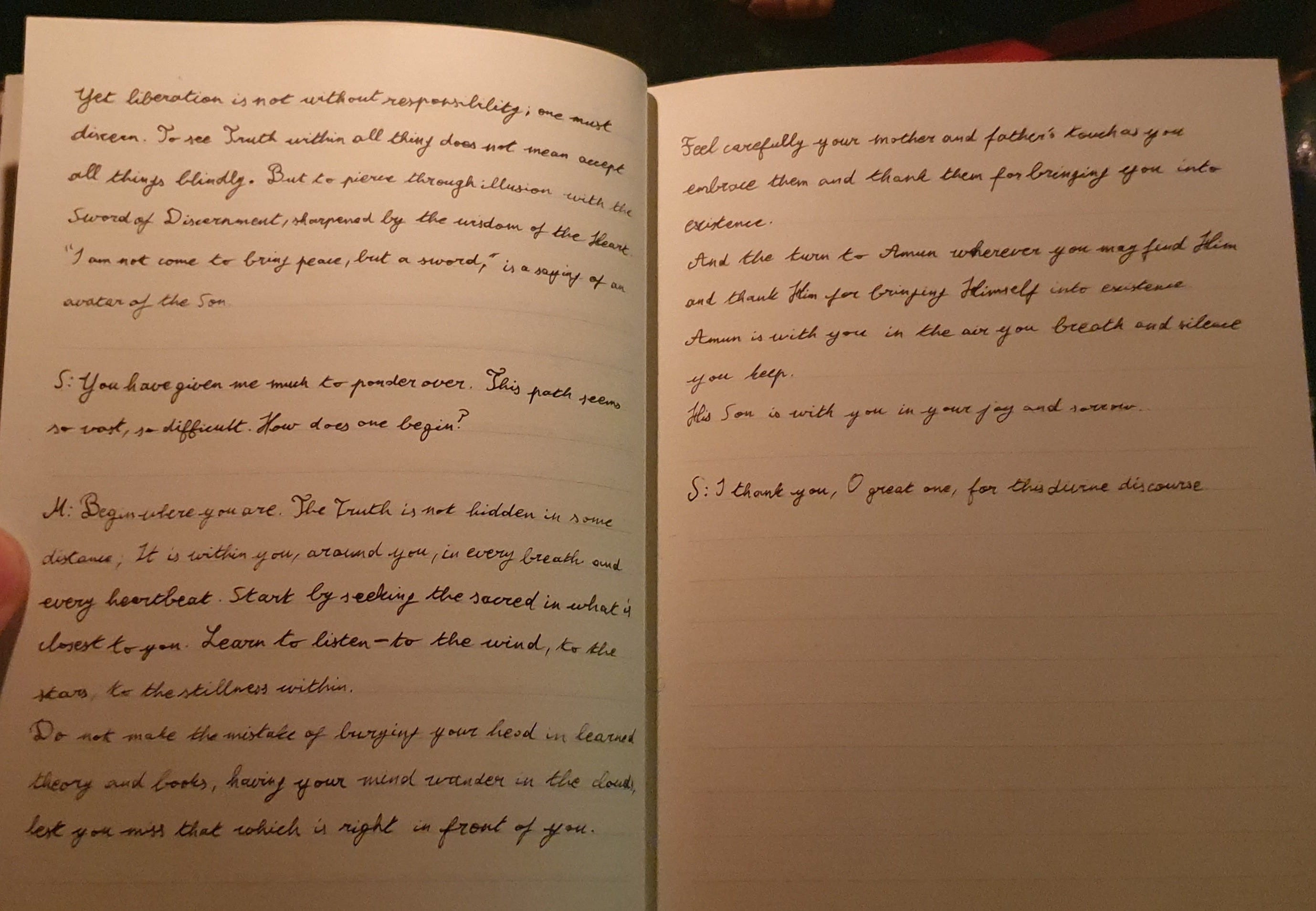
Yet liberation is not without responsibility; one must discern. To see Truth within all things does not mean accept all things blindly. But to pierce through illusion with the Sword of Discernment, sharpened by the wisdom of the Heart.
"I am not come to bring peace, but a sword" is a saying of an avatar of the Son.30
S: You have given me much to ponder over. This path seems so vast, so difficult. How does one begin?
M: Begin where you are. The Truth is not hidden in some distance; It is within you, around you, in every breath and every heartbeat. Start by seeking the sacred in what is closest to you. Learn to listen—to the wind, to the stars, to the stillness within.
Do not make the mistake of burying your head in learned theory and books, having your mind wander in the clouds, lest you miss that which is right in front of you.31
Feel carefully your mother and your father's touch as you embrace them and thank them for bringing you into existence. And then turn to Amun, wherever you may find Him and thank Him for bringing Himself into existence.
Amun is with you in the air you breathe and silence you keep.
His Son is with you in your joy and your sorrow.
S: I thank you, O great one, for this divine discourse.
Already at the very beginning of the text, it is stated that everything you could ever possibly need is already within you, if you dare to look deep enough. What you seek may be referred to in a book but will ultimately not be found in any book. “For then wilt thou upon It gaze when thou canst say no word concerning It. For Gnosis of the Good is holy silence…” says Hermes Trimegistos in Corpus Hermeticum X, The Key. Jesus Christ was also silent when Pilate asks him “What is truth?” for a reason.
This is ironic given that Hermes Trismegistos does nothing but speak about it throughout the Corpus. And yet, one who has experienced Gnosis, has to speak about it if we are to guide others to it. Only you yourself can “Remember” Truth, but you need proper guidance. Because most of us wouldn’t even know where to start to look for Truth within.
Truth will always, always stand above opinion. The majority of the world is run on opinion. Opinions change, they are passible, subject to death the same way material is subject to change and death. Truth is like Spirit, it is immortal.
God
Abbas The Alchemist, in his Youtube video “Dead/Pan and the Metaphysics of Mud” says: “Placate your ego, while telling yourself that it’s ascending to the heights of Heaven. Or dip your toes ever so gently into the depths of Tartarus and call it a confrontation with the Shadow. The shadow is mired in shit. So show me your palms, your clean manicured beautiful hands marked with the calusses of life. But where is the shit? Where is that noisome putrid smell, the filthy evidence of all your hard work? Or did you wash it away in your last cold shower or ice plunge?”
A beautiful demonstration of the egotistic, narcissisic side to modern spirituality, where everyone is trying to “ascend”, and even the smallest daring of descent, suddenly makes one a guru of the underworld. The Truth is not comfortable, it is dirty, smelly, it is full of the echoes of the dead screaming at us to turn around and face them. The dead are shit, dirt and mud from the earth, yet the earth is a goddess. That makes the muddy dead as gods, holy.
Hermes Trismegistus
In the next few lines, it will be a very clear reference to the beginning of the second tractate of Corpus Hermeticum, To Asclepius.
If the Cosmos is a body that moves, then that in which it moves must be bodiless and still.
The First Mound being a pyramid is the 3 pointed realm, representing the 3 dimensions height, width and depth.
An absolute view of the world as being fully Holy, due to every single thing in it being of God. This is hard to grasp, even for the most pious of godly people. Saying that shit, vomit and other “unclean” products of the human body is holy and of God is short of being heretical to many religious people. And yet, if you discriminate against those things, you discriminate against the creations of God. Even if you don’t believe that everything is of God, you must as a religous person agree that everything is created by God. And who are we humans to say that one thing in creation is less worthy than another in terms of its holiness? It is not up to us to decide, as far as we are aware; everything is holy because it is all from our Creator.
Satan. In this case, it is just a general term to refer to something that is evil. Discrimination is the way to seperation, and that is evil thinking. ““Good”” thinking is realizing that all is Holy, without discrimination, because all is of God.
A paradox. One must reconcile with all things, and that includes evil, discrimination and seperation. Even these things are Holy and of God. If all is One, and All. That includes duality within that unity. We are just experiencing the dual aspect of Unity, but that still means that it’s all united. And yet it’s not. Thinking this paradoxical way will lead you to be confused, even a bit crazy. But God includes all paradoxes, and so we must make peace with all of them as being Holy.
Read the previous substack post, Dawn. The master is here refering to that story.
The master believes in the absolute Truth as being that of Amun and His Revelation. Yet he is aware that other people on other parts of the globe may have had revelations with different names, such as Brahman, Allah, Zeus, YHWH etc. These are all the same entity, but revealed differently depending on the person the revelation was done to. Even in the ancient land of Kemet (Egypt), the One Great God was known in different names as Atum, Ptah, Ra, Amun.
That is to say, God is always God. His Revealing and us seeing Him differently doesn’t make Him different in nature. He is always the same, but because He is God and encompasses All things, different people “pick up” different aspects of His Being.
In today’s democratic society, many people can truly believe in the Spaghetti Monster if they want, that is their truth. And yet it is not obligatory to respect these “truths” as truths just because they want it to be true. One can accept it, show acceptance, this is important. But not respect it. Absolute Truth is Absolute Truth, some people know it, some people don’t. This is again, hard to accept for people in our democratic frame of mind, that someone claims they might know something of true value that you don’t is triggering to some.
Absolute Truth will always align with Absolute Truth, even if the different forms these take can vary in the small details. There is clear difference between Brahman, Allah and Amun, and yet if one has discerning skills, one can make out the underlying universal aspects of Truth in them.
Kata ton daimona eautou. Meaning: Act in accordance to the Spirit (daimona) within. Stay true to your own Spirit. Do what thou wilt. etc. It was written on the tombstone of Jim Morrison. This Daimon, (where we get the word Demon from) is something each of us have. In many cultures, there have been the “spirit teachers”, these can take many forms. Sometimes the form of an ancient person long gone, a creature, an actual demon, or just a reflection of you. In the Thelemic system of Aleister Crowley, it’s called The Holy Guardian Angel. For Crowley, it was the being Aiwass, for Peter Kingsley, he somewhat claims it’s the pre-socratic Empedocles, for Carl Jung himself it was Philemon.
The main law in Thelema.
An epiphet of Dionysos. This part of the text refers to a common misconception of the Dionysian rites as being hedonistic parties where you could just give in to every one of your urges, whims and desires. Most people imagine Dionysos as simply being a party god of wine.
Where we get the word hedonism from.
True worship of God is acting in accordance with natural law, Ma’at. Not because a book tells you that you’ll burn in eternal hellfire if you don’t. But because through your personal relationship with God, it would be a far worse punishment to see a dissapointed look on “His face” and hear the words “you could have done better my son.”
True Will always transcends morals, laws and other human inventions but it will never transcend natural Divine Law, or Ma’at. And it will never lead to undeserved pain, suffering or the degredation of your body. If you think you are following your Will and yet your body is screaming for you to treat it better, or you’re creating pain and destruction everywhere you go; then you should probably reconsider what your True Will is.
Read On Nature by Parmenides, or you can watch this video I made where I try to explain the poem
This is the ultimate reason why we are here on earth. The gods are screaming out at us to touch and experience reality fully, and yet we are asleep. Most of us have never seen anything before, smelled anything or felt anything. We think we do, and we take it for granted that we are aware of these things. But until you try actually being aware of your senses fully, not thinking about being aware of them; you will never know what it’s like. I will go into this more in future texts.
Our scattered senses are to be unified, as one.
Realizing that everything is an illusion and trying to get away to some kind of ultimate spiritual reality is futile, for ultimately; this is all we have. And yet the gods are generous, for all we have is All there Is, and we can drink this illusion to the dregs (not hedonistially, but consciously).
Minoans
“Moving stillness” is when you seemingly move or dance, but your mind is so still and focused, fully aware on your movement that you actually feel completely at still. “Still movement” refers to the practice of incubation. Where one would lie down in a cave or a holy space and “Die before you die”. Your body was so still that you could be mistaken for a dead person, and yet in you, you were traveling through all reality amongst the imperishable stars.
There’s nothing outside of All there Is, because then it wouldn’t be All there is. And so we can never leave or escape reality, even if we die. We are still within reality, consciousness is ongoing and never dies and is eternal.
The idea of freedom in voluntary bondage reflects the seemingly eternal philosophical debate about “free will vs. fate/determinism”. Johann Wolfgang von Goethe put it very well when he said: "One only has to declare oneself to be free, in that moment on feels oneself as limited. But if one dares declare oneself to be limited, one feels oneself to be free.” Or Carl Jung said: “Free will is doing gladly and freely that which one must do”.
Again, our modern democratic, individualistic world-view wants everyone to be their own individual being and “do what you want and feel like”. And then we dare talk about “ego-dissolution” and trying to “become one” and live “in harmony with nature”. And yet most people refuse to submit themselves to the Greater Flow of the gods and of Natural Law because it’s uncomfortable? In this world-view I’m trying to present, the greatest freedom is to be found when one fully submits oneself. That is to say, forms one’s inner world to move in comformity with the rythms of Cosmos, and all that is in it.
Jesus Christ.
A warning against overly philosophizing, burying your head in books and not going out there to live life. Philosophy (philo[love]-sophia[wisdom]), the love of wisdom is there to teach you how to live life properly. Not to live for the sake of philosophy but by it.
Without philosophy we are simply asleep as we go through life. With too much pilosophy, we continue dreaming.
Amun simply wants you to wake up. Wake up.
We are all seekers and masters.